Sunday, January 3, 2010

Kampung Kali Chode, Yogyakarta Indonesia

Kampung Code
view of the village from the bridge

Kampung Code
2 completed houses with freshly coated paint

Kampung Code
Kampung Chode at night

Kampung Code
the beacon of the village - the multipurpose hall built in the unique A-frame style

Kampung Code, Yogyakarta
houses under construction

Kampung Code, Yogyakarta
houses under construction

The pro-con team was part of a group of 13 youths, Building Lives 2009, who recently went on a mission to rebuild the houses at Kampung Chode, a humble village hugging the banks of Chode River on refuse dumps. An Aga-Khan Award winning project, the architecture of these squatter houses detailed the aspiration of the architect who fought to upkeep the life of this village -- originally reputed to house poor, unhealthy, undesirable groups of people outcast by the society. Hence, on countless times, the settlement tittered on the fear of being demolished. Connected by intricate alleys and terracing steps (with extremely steep ones too), the houses were simple, functional and unique. The structures were lightweight (consisting of timber structures and bamboo woven walls and windows) and were raised above ground on pilotis due to poor soil conditions. Interestingly, these raised platforms allowed livestock inhabitants of multi-coloured chicks to roam about, and were temporary shelves for villagers while they cooked or did their washings. Despite being on actual site for only full 7 days, we completed 2 houses (that could house 4 families in the double storey structure), and given them fresh coats of colour. We grew to love the village: we go to know the names of the giggling kids who would sit by us when they came back from school sipping their cyan blue drinks (I later learnt from one of the girls that it was blueberry), we bought pineapple tarts & butter cookies from the housewives who baked in the makeshift kitchen at the multipurpose hall, we knew the friends of the chicks and sort of knew where they belonged. City folks like us tend to romanticize the 'kampung' lifestyle, thinking that dipping our legs in the river and strolling down river banks are ideal getaways from the bustling city life. Yet seeing old folks climbing up steep stairs or sieve through rubbish wastes and make do with just that handful of belongings is painful. Or merely watching children walk happily barefoot in our construction site while we were heavily guarded with protection gloves, masks and shoes makes me realise that disparity which exists in our clouded ideal world.

Thus, in many ways, they built our lives too.

Some original project details of this village:
Architect: Y.B. Mangunwijaya
Site: under the Gondolayu Bridge
Design: 1983-85
Site Area: 3,600 sqm

Drawings' source to be verified.

Tuesday, December 29, 2009

Still on a break


GOOD MORNING CATS!, originally uploaded by jonolist.

heh heh

Friday, November 27, 2009

Split House @ Still Road

Split House @ Still Road #1

Split House @ Still Road #2
Split House @ Still Road


URA Conservation Plan (source: URA)

I came across this house while scouting for a site for my thesis project. And interestingly, to me, this split house was a jarring evidence that showed the 'insensitive' imposition of infrastructural plans on existing urban fabric.

A lil background information on the house (the information I gathered is as of now, not substantiated):
The Grand Hotel, aptly named, was built in 1920 in Victorian and pseudo-high renaissance architectural styles. Before becoming a hotel, it was one of the grandest private houses on the road. Owned by an Indian cattle merchant Moona Kadir Sultan, it was also called Karikal Mahal after its owner's birth town. It was converted into a hotel in 1947 and still stands in its almost original form. When Still Road was constructed in 1973, the house was split into 2 portions. Somewhere in 2000, the Grand Hotel was closed down due to poor business and since then, it has been abandoned. In early 2009, half of the house was gazetted a conservation area.

Thursday, October 22, 2009

of SIT flats

Remember the dissertation that I was working on with regards to the SIT flats? See
Of Charm, Rereading SIT flats & of SIT flats @ Chinatown, I manged to comb through the archive and found some interesting newspaper clippings of the 40s, 50s, and 60s that suggest some tangential readings of its history.

Thursday, July 9, 2009

A Lost World

Thanks Darryl for your kind contribution. =)


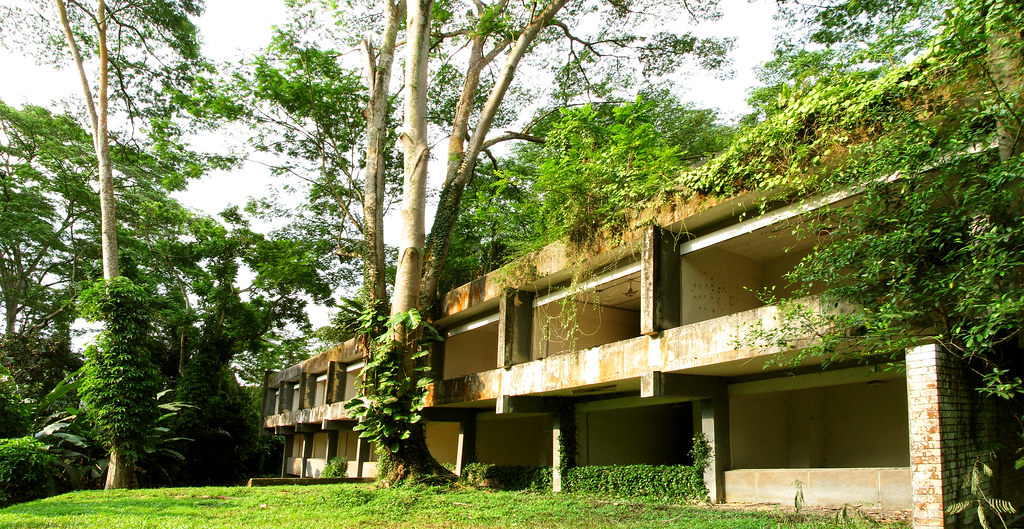
One of the unique qualities of Dempsey is its state of transition. You've got high-end lifestyle destinations atop the hill and yet untouched history in the surrounding environs of Harding Road, Loewen Road and Ridley Park. No doubt a very idyllic setting for that occasional tea for two, it also makes good fodder for contemplative walks alone. I chanced upon this beauty while waiting for church to start last Sunday. Having explored the old barracks along Loewen Road, on impulse, I veered off the main road, trekked through a clearing and there she was.

My heart skipped a beat.

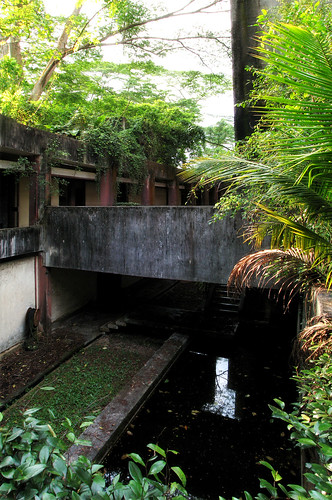
Tucked away amid dense tropical jungle, you do get the palpable sense of crossing over into another time stream; a real-life 'Bridge to Terabithia' encounter, right down to the threshold of having to cross a waterway, in this instance, a storm-drain.


The architecture stems from two periods, the consulate buildings at the front of the complex look old enough to be pre-war, whilst the newer extension at the back recall the sincere RC experiments of the 1970s. Its construction is simple and clearly expressed - utilising an age old strategy of extending the beams beyond the floor slabs thereby achieving a tectonic quality of one thing supporting another and a visual language of horizontal and vertical linearity. Closer inspection of the individual rooms reveals a sensitivity to climate and affordance. Each room is bestowed with an enchanting view of the surrounding green through sliding windows that reach from a cill height of about 600mm to the ceiling, thus creating the impression of a room enclosed by three walls and fully opened on one side - another strategy known as 'prospect', as termed by Glenn Murcutt. Even rainwater disposal gets accorded attention - a rectilinear protrusion breaks the horizontality of the roof slab and connects to a hollow square section pipe, similar in profile as the railings though of understandably larger dimensions, which then proceeds to decant rainwater into a receiving RC trough on the ground floor.


As much as the building has been lost to the onslaught of the jungle, so too has the architectural heritage that first gave it form. It is a masterful work that combines clear-headed planning, collected concrete construction, climate, comfort and controlled composition - qualities that defined the age of Peter Blundell Jones, Sonny Chan Sau Yan and Geoffrey Bawa, when schools still trained competent architects who could call the shots and inspire confidence in their clients.

To the unknown ancestor who crafted this gentle beast, I tip my hat to you.

of SIT flats @ Chinatown

"– I was asked to return to my cell. The cell was very small and there were 13 persons inside it. The room was wet, and everybody was wet inside; urine was on the floor all over. "
- witness account from war trial prosecution

SIT @ Smith Street
SIT flats @ Smith Street

Do you see the resemblance to the pre-war SIT flats that still fondly stand in Tiong Bahru? These SIT flats at New Bridge Road were built in 1938 and demolished in 1975 as the Kreta Ayer Centre was being built. During the period of the Japanese Occupation, it was temporarily converted to the Kempetai West District Branch, a house became a place of torture.

Saturday, July 4, 2009

Chin Mei Chin Confectionery

Chin Mei Chin Confectionery was founded in 1925 by a Hainanese family and is now run by its second generation boss who was the founder's son. They serve old school nostalgia in the form of sock pulled coffee (best ever), kaya butter buns (heavenly) and softboil eggs which don't really need brackets cuz their TODIEFOR!

DSC_0234

DSC_0235

Gotta love the patterning deco which was really the in thing back in the past and is receiving a retro comeback everywhere these days.

DSC_0245

Chin Mei Chin Confectionery


DSC_0247

and now to end with some of the nomnoms!

Soft boiled eggs
Soft Boiled Eggs

Kaya Butter Buns
DSC_0277

Chocolate Glaze

Chocolate Glaze


go visit Chin Mei Chin at 204 East Coast Road, its just opposite Church of The Holy Family in Katong.